
Today, two terms keep popping up in conversations about TV and streaming: IPTV and OTT. People often mix them up. Yet they work in different ways. Knowing the difference between IPTV and OTT helps you pick the right service. It also helps businesses choose the best way to deliver content.
This guide answers what is the difference between IPTV and OTT. It covers key points in plain language. You will see a clear comparison, learn about subscriptions, find real examples, and get answers to common questions. Everything stays easy to read and useful.
What Is IPTV?
IPTV means Internet Protocol Television. It sends TV channels and videos over a private network. A telecom company, internet provider, or cable operator usually controls that network.
The provider manages the full path from the server to your device. This lets them guarantee steady quality. Live channels often use a smart method called multicast. One stream reaches many viewers at once. This saves bandwidth.
Most IPTV services need a set-top box or a special app. You get live channels, a program guide, catch-up TV, and on-demand shows. Picture quality stays strong, and delays stay very low—often just one or two seconds.
What Is OTT?
OTT means Over-The-Top. It delivers videos straight over the regular public internet. The service sits “on top” of whatever internet you already use. No special cable or managed network is required.
You watch through apps or websites on phones, tablets, smart TVs, streaming sticks, or computers. The provider cannot control your home internet. Quality depends on your speed and how busy the network is. Smart tools like adaptive streaming and content delivery networks help keep playback smooth.
OTT shines with big libraries of movies, series, and original shows. It also offers more live sports and events every year. You can watch almost anywhere with an internet connection.
What Is the Difference Between IPTV and OTT?
The main difference between IPTV and OTT is control of the network.
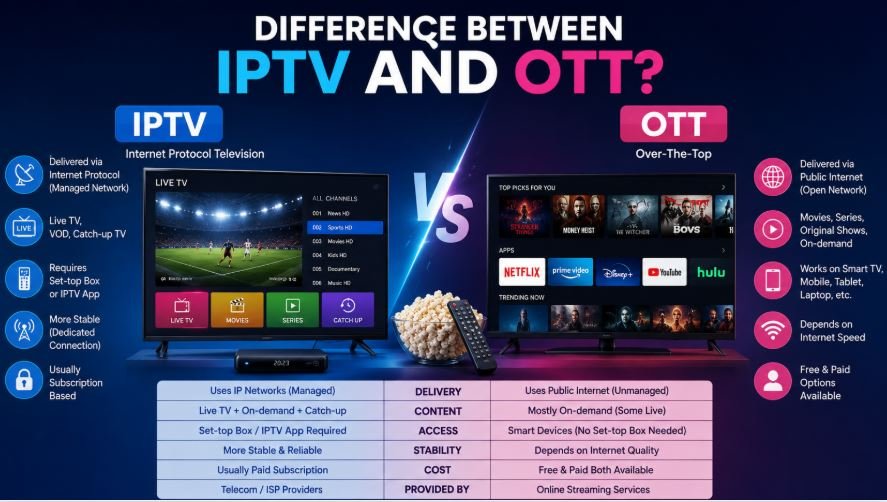
IPTV runs on a closed, managed network. The provider controls quality, speed, and security. Live TV feels fast and reliable. Reach stays limited to the provider’s area and approved devices.
OTT runs on the open internet. Anyone with internet access can use it. Devices are almost unlimited. Quality can change with your connection. Live streams usually have a bit more delay, though new technology is closing that gap.
In simple terms: IPTV focuses on steady quality inside a controlled system. OTT focuses on easy access from anywhere on any device.
IPTV VS OTT Comparison
Here is a clear side-by-side look at the biggest differences:
- Network: IPTV uses a private, managed network. OTT uses the public internet.
- Quality control: IPTV guarantees steady performance. OTT depends on your internet speed.
- Live delay: IPTV is usually under a few seconds. OTT can be longer, but low-latency options are improving fast.
- How content is sent: IPTV can send one live stream to many people at once. OTT sends a separate stream to each viewer.
- Devices: IPTV often needs a set-top box or special app. OTT works on almost any internet device.
- Where you can watch: IPTV is usually limited to one region or network. OTT works worldwide.
- Security: IPTV uses network controls plus extra protection. OTT mainly uses digital rights tools.
- Cost to build: IPTV needs more network investment. OTT costs less to start and grows with cloud tools.
- Best use: IPTV fits telecom packages, hotels, and controlled places. OTT fits global streaming brands and flexible apps.
OTT and IPTV Subscription Models
How you pay also differs.
IPTV plans often come bundled with your internet or phone service. You pay one monthly fee for live channels, some on-demand shows, and the equipment. Extra sports or movie packages cost more. The plan usually ties to one home or account.
OTT plans give more choices:
- Monthly or yearly subscriptions for full access
- Free versions supported by ads
- Pay only for single movies or shows
- Free live channels with ads
- Mix of free and paid tiers
OTT services are easy to start and cancel. Many let several people watch at the same time on different devices. Prices often start lower than traditional packages. Still, families sometimes buy several services, which can raise the total monthly cost.
Many companies now offer hybrid options. You get reliable live TV through a managed network and the same content on mobile apps over the open internet.
Read also more related topics: Difference Between IPTV and Streaming TV
Difference Between IPTV and IFTV
IPTV vs OTT Comparison Chart
Here is a clear side-by-side comparison of IPTV and OTT. The table highlights the main differences in simple terms so you can quickly see which option fits your needs.
| Feature | IPTV | OTT |
|---|---|---|
| Network Type | Private, managed network controlled by the provider | Public internet (open network) |
| Quality of Service | Guaranteed and consistent | Depends on your internet speed and connection |
| Live Latency | Very low (usually 1–3 seconds) | Higher (several seconds to tens of seconds; improving with new tech) |
| Content Delivery | Multicast (one stream serves many viewers) + unicast | Mostly unicast (separate stream for each viewer) |
| Device Support | Often limited to set-top boxes or approved devices | Works on almost any internet-connected device (phones, smart TVs, tablets, sticks, computers) |
| Geographic Reach | Limited to the provider’s service area | Global – watch anywhere with internet |
| Content Protection | Network-level controls + DRM | Mainly DRM (digital rights tools) |
| Infrastructure Cost | Higher (needs managed network and often special hardware) | Lower (uses cloud and content delivery networks) |
| Setup & Flexibility | May need installation or special equipment | Simple app download or browser access |
| Best For | Live TV, telecom bundles, hotels, campuses, controlled environments | Movies, series, global streaming, flexible on-demand viewing |
| Subscription Style | Often bundled with internet or phone plans; fixed monthly fees | Flexible: monthly subscriptions, free with ads, pay-per-view, or hybrid plans |
Examples of IPTV and OTT
IPTV examples
- Telco TV services like AT&T U-verse or Verizon Fios
- IPTV services such as Polu TV, Pixzo TV, or Zest IPTV
- Systems used in hotels, hospitals, and campuses
- Legitimate provider-managed live TV with set-top boxes
OTT examples
- Netflix, Disney+, Amazon Prime Video, Apple TV+, Max, and Hulu
- YouTube and YouTube TV
- Live streaming services such as Sling TV or Fubo
- Free ad-supported platforms like Pluto TV, Tubi, and The Roku Channel
- Sports apps that stream events over the internet
Some services blend both styles. They offer managed delivery at home and open-internet apps on the go. The core technology still decides if it is mainly IPTV or pure OTT.
Frequently Asked Questions
What is the main difference between IPTV and OTT?
IPTV uses a private network that the provider controls for steady quality. OTT uses the public internet and works on any connected device.
Is IPTV better quality than OTT?
On a strong managed network, IPTV can feel more consistent for live channels. Good OTT services with solid internet still look and sound excellent for most people.
Can OTT replace IPTV for live TV?
Yes for many viewers. Services like YouTube TV offer large channel lineups. Places that need rock-solid reliability still prefer true IPTV.
Which costs less—IPTV or OTT?
Single OTT plans often start cheaper. Adding several OTT services can cost more than one IPTV package. Bundles with internet can make IPTV competitive. Prices change by location.
Do I need special gear?
IPTV often needs a set-top box from the provider. OTT only needs an internet device and the right app or browser.
Are all online “IPTV” services real IPTV?
No. Many marketed as IPTV are actually OTT-style streams over the public internet. True IPTV uses a managed network. Always check that the service has proper rights to the content.
Conclusion
The difference between IPTV and OTT comes down to control versus freedom. IPTV gives reliable quality and low delay inside a closed network. It works best for traditional TV experiences and controlled settings. OTT gives wide reach, device freedom, and flexible pricing. It works best for modern streaming and global audiences.
In 2026, many providers combine both. You enjoy steady live channels at home and the same content on any device while traveling. Viewers get more choice. Companies pick the method that matches their goals.
Whether you want live sports, big movie libraries, or both, knowing IPTV versus OTT helps you decide wisely. Choose managed IPTV when steady quality matters most. Choose OTT when easy access and flexibility come first. Often the smartest choice is a mix of the two
3 thoughts on “Difference Between IPTV and OTT? Simple Guide to Modern Streaming”