
Choosing how you watch TV has never been more important. Traditional satellite services and modern internet streaming now compete head-to-head. Many people ask the same question: which is better in the IPTV VS DTH debate?
This guide gives you clear overviews of IPTV and DTH. It explains the key difference between IPTV and DTH. You will also see the pros and cons of each option, real-world examples, and a simple answer to which one works better for your streaming needs.
Overviews of IPTV and DTH
What is IPTV?
IPTV stands for Internet Protocol Television. It sends live TV channels, movies, and on-demand shows over the internet. You do not need a satellite dish or cable line. Instead, you stream content through a broadband connection. You can watch on smart TVs, Firesticks, Android boxes, phones, or computers. Most IPTV services also offer catch-up TV, electronic program guides, and large libraries of movies and series.
What is DTH?
DTH stands for Direct-to-Home. It is a satellite television service. A dish on your roof or balcony picks up signals from a satellite. A set-top box turns those signals into TV channels. Popular DTH providers usually offer fixed channel packages. Many also include high-definition options and some limited on-demand content.
In short, IPTV travels through your internet connection. DTH relies on satellite signals that come straight to your home.
What is the Difference Between IPTV and DTH
| Feature | IPTV | DTH |
|---|---|---|
| Delivery Method | Internet (broadband) | Satellite dish + set-top box |
| Installation | Minimal (just an app or player) | Dish installation required |
| Internet Dependency | High – needs stable broadband | None for viewing (internet is optional) |
| Channel Flexibility | Often thousands of channels + VOD | Fixed packages, fewer international options |
| Portability | Watch anywhere with internet | Limited to the home with the dish |
| Picture Quality | Depends on internet speed (up to 4K) | Consistent HD/4K when the signal is strong |
| Weather Impact | Not affected by rain or storms | Can lose signal in bad weather |
| Cost Structure | Monthly plans that are often flexible | Monthly plans plus installation and hardware fees |
| Multi-device Support | Excellent (phones, tablets, TVs) | Usually limited to the set-top box |
The core difference between IPTV and DTH is simple. One uses the internet. The other uses a satellite dish. This change affects flexibility, cost, and how you watch every day.
Pros and Cons of IPTV and DTH
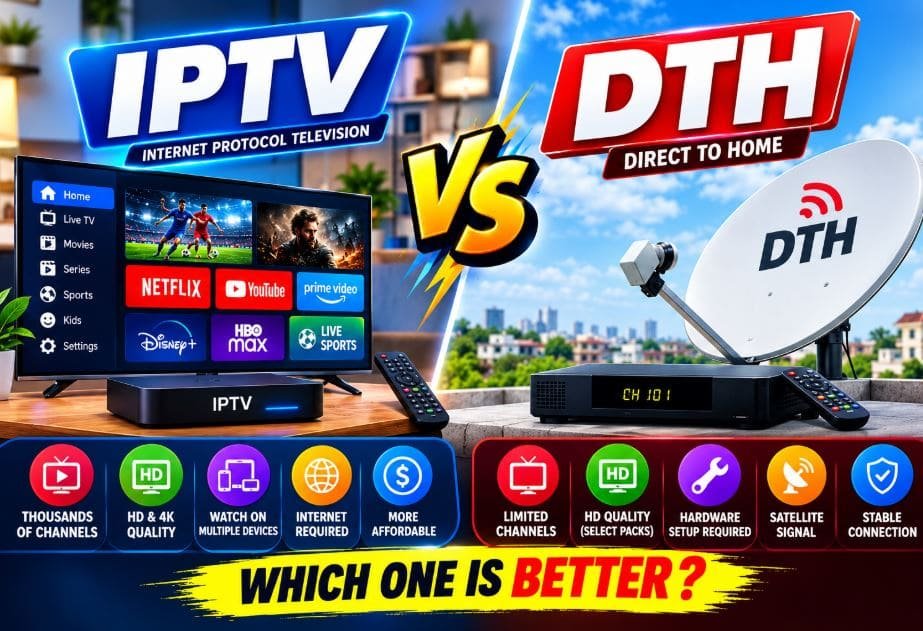
Pros of IPTV
- Huge choice of channels and international content
- No dish or complex installation needed
- Watch on many different devices
- Often includes large libraries of movies and series
- Easy to start, pause, or cancel your plan
- Great for sports fans who want wider coverage
Cons of IPTV
- Needs a stable and reasonably fast internet connection
- Picture quality can drop if your bandwidth is limited during busy hours
- Some providers may raise questions about reliability or legality (always pick trusted services)
- Performance depends on your internet provider
Pros of DTH
- Reliable signal that does not need the internet
- Steady picture quality when the satellite signal is clear
- Simple setup for many users after the dish is installed
- Strong coverage in places with limited broadband
- Support from established major providers
Cons of DTH
- Needs an outdoor dish and a clear line of sight to the satellite
- Heavy rain, snow, or storms can interrupt the service
- Channel packages are less flexible
- Harder to watch on multiple devices or while traveling
- Higher long-term costs in many markets because of hardware and monthly plans
Examples of IPTV and DTH
IPTV examples
Many IPTV services focus on live sports, international channels, and on-demand libraries. Viewers often look for services that appear in guides about the best options for live sports, UK providers, or specific countries. Most modern IPTV platforms work well on Firestick, smart TVs, and mobile apps.
Some popular IPTV services are YouTube TV, Roku TV, Polu TV, Zest IPTV, Fubo TV, Pixzo TV, etc.
DTH examples
Well-known DTH services come from major satellite companies. They offer national and regional channel packages, HD or 4K options, and set-top boxes that can record shows. These remain popular in homes that prefer a traditional fixed setup.
Some DTH services market are Foxtel, DirecTV, Viasat, AUSTAR United Communications Limited, Astro All Asia
Which One Is Better for Your Streaming: IPTV or DTH?
The best choice depends on your situation.
Choose IPTV if you have reliable broadband. It works well if you want maximum channel variety, multi-device access, and flexible pricing. IPTV also suits sports fans who want fewer blackouts. It is a strong option for cord-cutters, people who travel often, and households that already stream a lot of content.
Choose DTH if your internet is slow or unstable. It is also a good fit if you live in an area with excellent satellite reception. Many people pick DTH when they want a simple system that does not depend on broadband.
For most viewers in 2026, IPTV offers greater flexibility and better value. This is especially true when you have a strong internet connection. Still, DTH keeps a clear advantage in reliability for users in low-broadband regions.
If you want to explore IPTV further, check out related guides such as the difference between IPTV and cable TV, the best IPTV for live sports, or reviews of top UK IPTV providers.
Frequently Asked Questions (FAQs)
What is the main difference between IPTV and DTH?
IPTV streams content over the internet. DTH receives signals through a satellite dish. IPTV is more flexible. DTH works without depending on your internet quality.
Is IPTV better than DTH?
IPTV is usually better for variety, multi-device use, and flexible pricing. DTH is better for steady performance in areas with weak internet.
Does IPTV need a strong internet connection?
Yes. A stable broadband connection helps a lot. Aim for at least 25 Mbps for smooth HD or 4K viewing.
Can bad weather affect DTH?
Yes. Heavy rain, snow, or storms can weaken or stop the satellite signal. IPTV does not face the same weather problems.
Which is cheaper: IPTV or DTH?
IPTV plans are often more affordable over time. They usually avoid large installation fees. DTH often includes hardware costs plus monthly packages.
Can I use both IPTV and DTH?
Yes. Some households keep DTH for reliability and add IPTV for extra international channels or sports coverage.
Conclusion
The IPTV VS DTH choice comes down to your lifestyle and your internet setup. IPTV gives you modern flexibility, a wide range of content, and the ability to watch on many devices. DTH gives you dependable satellite delivery that keeps working even when the internet is slow or down.
Look at your internet speed, how you like to watch TV, your budget, and where you live. For most people who want a flexible streaming experience today, IPTV currently offers the stronger overall package. Test a few trusted options, check the reliability, and pick the system that matches the way you actually watch television.