
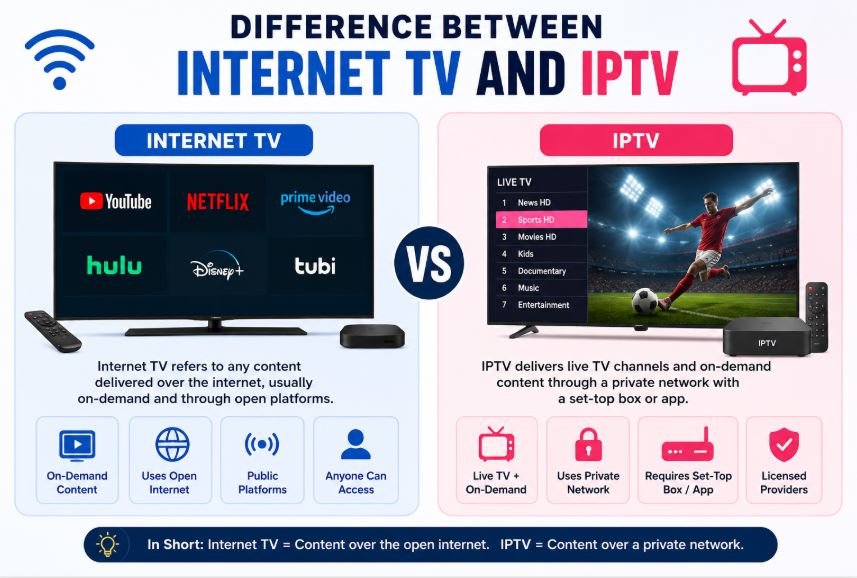
Many people use the terms Internet TV and IPTV as if they mean the same thing. They do not. What is the Difference between Internet TV and IPTV? Both deliver video over IP networks, but the way they work, the quality they offer, and the experience they give are quite different. Understanding Internet TV VS IPTV helps you choose the right option for your home.
Definition of Internet TV and IPTV
What Is IPTV?
IPTV stands for Internet Protocol Television.
It delivers live TV channels, video-on-demand, and interactive features over a private, managed network controlled by a service provider (usually a telecom or ISP). The provider controls the entire path from the server to your home. This allows them to guarantee Quality of Service (QoS).
Most IPTV services need a set-top box or a compatible smart TV app provided by the operator. Live channels often use multicast technology, which is efficient when many people watch the same program at the same time.
What Is Internet TV?
Internet TV (also called Over-the-Top or OTT television) delivers video content over the open public internet.
It does not rely on a private managed network. You simply need a regular broadband connection. Content reaches you through apps or websites on any internet-connected device — smart TVs, phones, tablets, computers, or streaming sticks.
Popular examples include Netflix, YouTube, Disney+, Hulu, Amazon Prime Video, and free live-stream platforms.
Internet TV VS IPTV Comparison Chart
| Feature | IPTV | Internet TV (OTT) |
|---|---|---|
| Network | Private, managed network | Public internet |
| Quality of Service | Guaranteed by the provider | Depends on your internet speed & traffic |
| Device Requirements | Often needs a set-top box | Works on almost any device |
| Live TV Delivery | Multicast (efficient for many viewers) | Unicast (one stream per viewer) |
| Reliability | Generally more stable | Can buffer during peak times |
| Content Flexibility | Limited to provider packages | Huge variety from many sources |
| Installation | Provider equipment usually required | Plug-and-play with existing devices |
| Cost Structure | Monthly subscription similar to cable | Often cheaper or free (ad-supported) |
Pros and Cons of Internet TV and IPTV
IPTV Pros
- Stable picture and sound quality
- Better performance for live sports and events
- Integrated electronic program guide and recording features
- Higher security on a closed network
IPTV Cons
- Limited to the channels and content the provider offers
- Usually requires a set-top box
- Higher monthly cost than many streaming options
- Less flexible if you travel or switch devices often
Internet TV Pros
- Access from almost any device and location
- Wide choice of content and services
- Lower cost or free options available
- Easy to start and cancel
- No special hardware needed in most cases
Internet TV Cons
- Quality depends on your internet connection
- Can suffer buffering during busy hours
- Live TV may have higher latency
- Content can be spread across many different apps
Examples of Internet TV and IPTV
IPTV examples
- Verizon Fios TV
- Pixzo TV, Polu TV, YouTube TV, and more.
- AT&T U-verse / DIRECTV STREAM (managed versions)
- MagentaTV (Germany)
- Many telecom operator TV packages worldwide
Internet TV examples
- Netflix, Disney+, Hulu, Max, Amazon Prime Video
- YouTube and YouTube TV
- Free platforms like Pluto TV, Tubi, and free ad-supported channels
- Live streaming apps from broadcasters
Which One Is Better: IPTV or Internet TV?
The better choice depends on your needs.
Choose IPTV if you:
- Watch a lot of live sports or news
- Want consistent picture quality
- Prefer a traditional TV experience with a program guide
- Already use the same provider for internet
Choose Internet TV if you:
- Want maximum flexibility and device choice
- Prefer on-demand content and lower monthly costs
- Travel often or watch on multiple devices
- Like mixing different streaming services
Many households now use both. They keep an IPTV or live TV service for sports and news, and add Internet TV services for movies and series.
Frequently Asked Questions
Is IPTV the same as streaming?
No. Streaming usually refers to Internet TV (OTT) over the public internet. IPTV uses a managed private network.
Does IPTV need a special internet connection?
It needs a reliable broadband connection, but the provider manages the network path for better performance.
Can I watch IPTV on my phone?
Some modern IPTV services offer mobile apps, but traditional IPTV is designed mainly for the home set-top box or smart TV.
Is Internet TV free?
Some services are free with ads. Most premium content requires a paid subscription.
Which is more reliable?
IPTV is generally more reliable for live TV because the provider controls the network. Internet TV quality depends on your broadband speed and how busy the public internet is at that moment.
Conclusion
The main difference between Internet TV and IPTV lies in the network. IPTV runs on a private, managed network that prioritizes television quality and stability. Internet TV runs over the open public internet and offers greater flexibility and variety.
Neither option is universally better. IPTV suits viewers who value reliability and live channels. Internet TV suits those who want freedom, lower cost, and a wide range of on-demand content.
Look at your viewing habits, internet speed, and budget. Then choose the solution — or combination — that fits your lifestyle best.
5 thoughts on “Difference Between Internet TV and IPTV”