

Cord-cutting keeps growing. Many people now ask about the difference between IPTV and Cable TV. Searches like “IPTV vs Cable TV” or “What is the Difference Between IPTV and Cable TV” show up every day.
This guide explains both options in simple terms. You will see how they work, their real pros and cons, clear examples, and a side-by-side chart. By the end, you can pick the one that fits your home and budget.
What Is IPTV?
IPTV means Internet Protocol Television. It sends live TV channels, shows, and movies through your broadband internet.
You watch on a smart TV, Fire Stick, Roku, phone, tablet, or computer. Good IPTV services give you a program guide, catch-up TV, cloud DVR, and multi-device access.
What Is Cable TV?
Cable TV is the classic system. It brings channels into your home through coaxial cables from the provider.
A set-top box receives the signal. You get a set list of channels that run on a fixed schedule. Most cable plans also offer some on-demand shows and a DVR.
What Is the Difference Between IPTV and Cable TV?
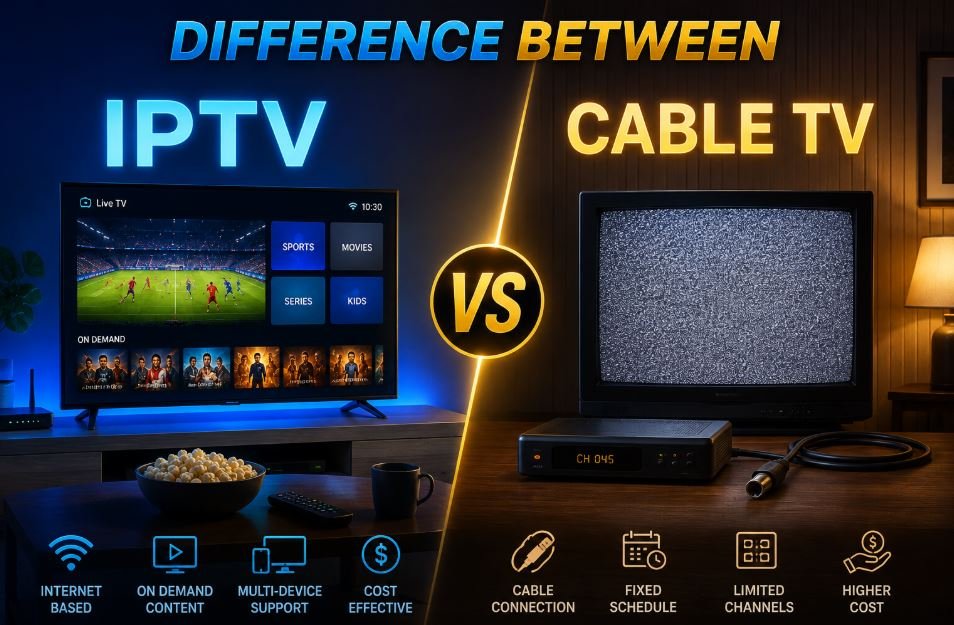
The main difference is how the signal reaches you.
- Cable TV uses physical coaxial cables.
- IPTV uses your internet connection.
IPTV works on many devices and often lets you watch away from home. Cable TV usually stays tied to the TV and box in your living room.
Cable needs the provider’s cable network. IPTV only needs steady broadband. Faster internet gives better results.
IPTV apps usually offer better search, recommendations, and restart features. Cable focuses more on simple channel surfing and a home DVR.
Cable often needs a technician. IPTV is usually just an app and login.
Pros and Cons of IPTV and Cable TV
IPTV Pros
- Watch on TV, phone, tablet, or laptop
- Often costs less, especially for cord-cutters
- Strong on-demand and catch-up options
- Easy to start or cancel with many plans
- Works while you travel (with good internet)
- Modern menus with search and suggestions
IPTV Cons
- Picture quality depends on your internet speed
- Buffering can happen on slow Wi-Fi
- Some services miss local channels in certain areas
- Cheap unauthorized services are illegal and risky
Cable TV Pros
- Picture stays stable even if Wi-Fi drops
- Strong local channels and emergency alerts
- Familiar channel-surfing many people like
- Often includes free equipment and install help
- Keeps working if your internet goes down
Cable TV Cons
- Monthly cost is often higher plus equipment fees
- Limited to the home TV in most cases
- Contracts and exit fees still exist
- Bulkier boxes and older on-demand menus
- Harder to take with you when you travel
Examples of IPTV and Cable TV
Legitimate IPTV / Live TV Streaming Examples
- YouTube TV
- Pixzo TV
- Sling TV
- Polu TV
- Hulu + Live TV
- Apps from cable companies like Xfinity Stream or Spectrum TV
These services send live channels over the internet.
Traditional Cable TV Examples
- Xfinity (Comcast)
- Spectrum
- Cox
- Optimum
- Suddenlink
- Local cable companies
These rely mainly on coaxial cables into the home.
Note: Some cable companies now offer streaming apps too. The core cable service still differs from pure IPTV.
IPTV VS Cable TV Comparison Chart
| Feature | IPTV (Legitimate) | Cable TV |
|---|---|---|
| Delivery | Internet (IP) | Coaxial cable |
| Device flexibility | High (TV, phone, tablet, PC) | Low to medium (mainly home TV) |
| Internet dependency | High | Low |
| Typical cost | Often lower, flexible plans | Often higher + equipment fees |
| On-demand & catch-up | Excellent | Good but usually more limited |
| Picture reliability | Depends on broadband quality | Generally very stable |
| Portability | High | Low |
| Installation | Self-setup (app) | Often technician required |
| Contracts | Many month-to-month options | Still common |
| Local channels | Varies by service and location | Usually strong |
| Best for | Cord-cutters, multi-device homes, travelers | Users who want simple, stable TV |
Which Should You Choose: IPTV or Cable TV?
Pick legitimate IPTV if you have fast internet, want to watch on many devices, like modern features, and prefer easy changes or cancellations.
Pick Cable TV if you want steady picture quality, strong local channels, less reliance on Wi-Fi, or the classic TV feel with a box.
Many homes mix both. Some keep basic cable for locals. Others go full cord-cutter with a top IPTV service plus a free antenna.
By the end, you can pick the one that fits your home and budget. People also explore related topics such as the Difference Between IPTV and OTT, the Difference Between IPTV and Streaming TV, and the Difference Between Kodi and IPTV.
Frequently Asked Questions
Is IPTV the same as Netflix?
No. Netflix is on-demand only. IPTV focuses on live channels delivered over the internet, often with extra on-demand shows.
Does IPTV need special equipment?
Usually just a smart TV or low-cost streaming stick. No cable box is required.
Can cable TV work without internet?
Yes. The traditional cable signal does not need your home internet.
Is cheap IPTV safe and legal?
Unauthorized low-cost services that resell channels without rights are illegal. They are also unstable. Stick to licensed providers.
Which is better for sports?
Both work well. Services like YouTube TV, Fubo, or Hulu + Live TV carry major sports networks. Traditional cable does too, and sometimes handles local blackouts better.
What internet speed do I need for IPTV?
Most services want at least 25 Mbps for HD. 50 Mbps or more is better for 4K and several streams at once.
Conclusion
The difference between IPTV and Cable TV comes down to delivery, flexibility, and daily habits. Cable TV offers steady, traditional service that does not rely on Wi-Fi. Legitimate IPTV gives more freedom, modern tools, and often better value for cord-cutters.
Neither option wins for everyone. The right choice matches your internet quality, devices, viewing habits, and budget. Once you understand IPTV vs Cable TV, you can stop overpaying and watch TV the way that works best for you.
8 thoughts on “Difference Between IPTV and Cable TV | Clear Comparison Guide”