
Looking for the real difference between IPTV and Sling TV? You’re not alone. As more people cut the cord, these two popular options often come up in the same search. One promises massive channel lists and lower prices, while the other delivers a polished, fully legal streaming experience with flexible packages. Understanding how IPTV and Sling TV actually compare can save you money, frustration, and buyer’s regret. In this guide, we break down the key differences in simple terms so you can choose the right service for your viewing habits.
Cord-cutting has opened up many ways to watch live TV, sports, movies, and shows. Two options that come up often are IPTV and Sling TV. If you are searching for “IPTV VS Sling TV,” “What is the Difference between IPTV and Sling TV,” or “Which is better IPTV or Sling TV?” this guide gives clear answers on price, channels, reliability, and real-world value.
You will also find practical examples of each service and answers to common questions so you can choose with confidence.
What Is IPTV?
IPTV (Internet Protocol Television) delivers television content over the internet using IP technology instead of traditional cable or satellite. It can include live channels, video-on-demand (VOD), catch-up TV, and electronic program guides.
There are two main kinds of IPTV:
- Licensed services from internet providers or official operators that use managed networks.
- Third-party IPTV subscriptions that often promote thousands of live channels, international options, sports packages, and large movie libraries at lower prices.
Viewers usually watch through apps, smart TVs, set-top boxes, or players that support playlists. Picture quality and stability depend on the provider and your internet speed.
Examples of IPTV
- Legitimate ISP-based IPTV services that come bundled with home internet in some regions.
- Some popular IPTV names are Pixzo TV, Naxa TV, Polu TV, and StreamView IPTV.
- Specialized third-party providers focused on large channel lists, including international sports and news.
- Services that combine live TV with extensive on-demand libraries and catch-up features.
These examples show the range: some feel like traditional cable delivered online, while others aim for maximum variety at a lower cost.
What Is Sling TV?
Sling TV is a fully legal over-the-top (OTT) live TV streaming service operated by EchoStar. It was built for cord-cutters who want popular cable channels without a long-term contract or expensive hardware.
Sling offers flexible base packages, optional add-ons, cloud DVR, and support for most major streaming devices. You can start with a small plan and add only the channels you actually watch.
Examples of Sling TV
- Sling Orange – focused on sports and family channels such as ESPN and Disney networks.
- Sling Blue – stronger on news and entertainment, often including local stations in select markets.
- Sling Orange & Blue combination – the fuller lineup for people who want both.
- Newer skinny bundles like Essentials or Select – lower-cost entry points with fewer channels.
- Short-term Day, Weekend, or Week Passes – useful when you only need access for a big game or event.
These examples highlight Sling’s modular approach: you pick the package that matches your viewing habits instead of paying for a fixed large bundle.
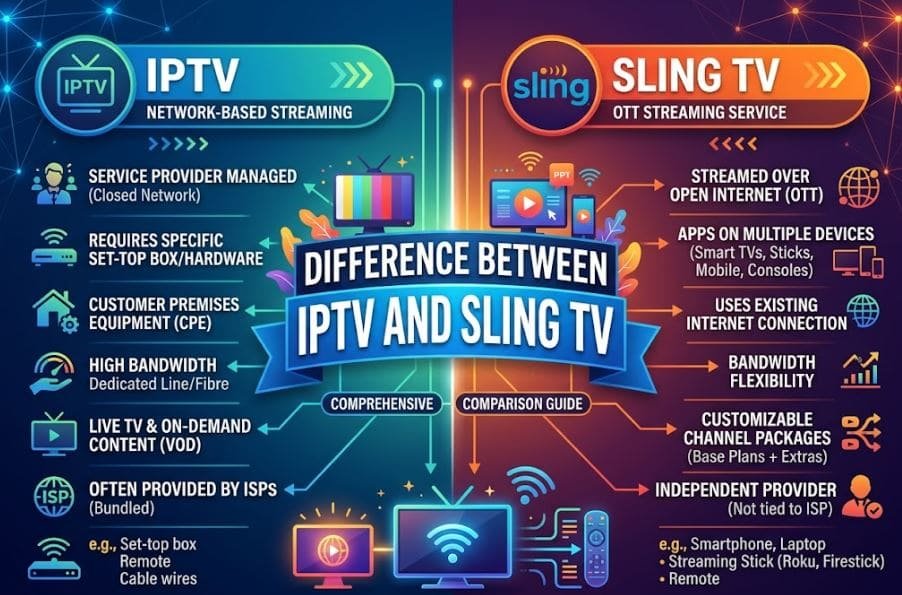
What Is the Difference Between IPTV and Sling TV?
The main differences appear in content volume, cost, legality, and day-to-day experience.
Delivery method
IPTV often uses dedicated or managed IP streams. Sling TV streams over the public internet through reliable content delivery networks.
Channel selection
Many IPTV services advertise thousands of live channels plus international and niche options. Sling TV offers curated packages that typically range from about 10 to 50-plus channels, focusing on popular U.S. cable networks.
Pricing
IPTV plans are frequently cheaper, especially on longer subscriptions. Sling TV starts at lower entry prices for skinny packages and moves into the mid-range for fuller Orange or Blue plans, with optional extras that raise the total.
Legality and reliability
Sling TV is a licensed commercial service with official network agreements, consistent quality, and customer support. IPTV quality varies widely. Licensed versions are fine, but many low-cost third-party options sit in a gray area and can experience stream drops or sudden channel changes.
Ease of use
Sling TV has a polished app, straightforward setup, and standard cloud DVR. IPTV setup can be simple or more technical depending on the provider and the player you use.
Pros and Cons of IPTV and Sling TV
IPTV Pros
- Often lower monthly or yearly cost.
- Very large channel counts, including international and specialty sports.
- Frequently includes extensive VOD and catch-up TV.
- Flexible for users who want global content.
IPTV Cons
- Quality and uptime depend heavily on the specific provider.
- Potential legality and reliability risks with unlicensed services.
- Setup can require more technical steps.
- Limited official support in many cases.
Sling TV Pros
- Fully legal and licensed content.
- High customization—you only pay for the packs you need.
- Reliable streaming and easy app experience.
- Built-in cloud DVR and short-term passes.
- No long-term contracts.
Sling TV Cons
- Smaller overall channel lineup than many IPTV claims.
- Limited local channels (CBS is usually missing; others vary by market and may cost extra).
- Total cost rises once you add multiple extras.
- Fewer simultaneous streams on some base plans.
IPTV or Sling TV Comparison Chart
| Feature | IPTV (Typical) | Sling TV |
|---|---|---|
| Monthly Price | Often lower, varies by provider | Entry-level skinny plans to mid-range packages |
| Channel Count | Frequently thousands claimed | 10–50+ depending on package |
| Content Focus | Live TV, sports, international, VOD | Popular U.S. cable, sports, news |
| Legality | Varies (licensed to gray-area) | Fully licensed |
| Reliability | Provider-dependent | Generally consistent |
| DVR | Varies | 50 hours standard (upgradable) |
| Simultaneous Streams | Often 1–2 or more | 1–4 depending on plan |
| Setup | Easy to moderate | Very easy |
| Best For | Maximum channels and value | Legal, customizable U.S. live TV |
Which Is Better: IPTV or Sling TV?
The better choice depends on what matters most to you.
Pick Sling TV if you want a legal, reliable service with popular cable channels, simple setup, and the ability to build a package that matches your actual viewing. It works especially well for people who prefer peace of mind and good customer support.
Pick IPTV (from a carefully researched, preferably licensed provider) if your priority is the lowest price, a huge variety of live and international channels, or deeper sports coverage. Be ready to check reviews for stability and understand any potential risks.
Many households combine approaches—using Sling or another licensed service for core channels and free ad-supported platforms or an antenna for extras.
Read also more related topics: IPTV vs YouTube TV
Difference Between IPTV and Cable TV
What is the Difference Between Kodi and IPTV
Difference Between IPTV and OTT
Frequently Asked Questions
1. Can I get local channels on both IPTV and Sling TV?
Sling TV offers local ABC, NBC, or FOX stations in many markets, sometimes with a small surcharge, but CBS is generally not available. IPTV availability of true local channels varies by provider and is not always reliable or officially licensed.
2. Is IPTV cheaper than Sling TV in the long run?
Many IPTV plans cost less per month, especially yearly options. However, the total value depends on reliability. Frequent buffering or lost channels can make a cheaper service more expensive in frustration. Sling’s pricing is transparent and predictable once you choose your package.
3. Do I need special equipment for IPTV or Sling TV?
Sling TV works on most smart TVs, streaming sticks, phones, and tablets with just an app and internet connection. IPTV may work the same way through apps, but some setups use dedicated boxes or players for the best experience.
4. Which option is better for sports fans?
Sling TV includes strong sports channels on certain plans (especially Orange) and offers add-on packs. Many IPTV services advertise broader sports coverage, including international leagues and more regional networks, but consistency can vary.
5. Is it safe to switch from cable to either service?
Sling TV is a mainstream, licensed service with established customer support, so the switch is straightforward and low-risk. For IPTV, choose providers carefully, read recent user feedback, and start with a short trial period if available to test quality before committing.
Final Thoughts
The difference between IPTV and Sling TV is mainly one of scale versus reliability and legality. IPTV can offer more channels and lower prices but requires careful provider selection. Sling TV delivers a polished, customizable, fully legitimate live TV experience that many cord-cutters find easy to live with.
Look at your must-have channels, monthly budget, internet quality, and comfort with different setups. Check current Sling plans and channel lists for your area, and research any IPTV option thoroughly. With the right choice, you can enjoy the TV you want without the traditional cable bill.
3 thoughts on “Difference Between IPTV and Sling TV | Complete Comparison Guide”