

Streaming television has changed the way people watch live sports, news, movies, entertainment, and TV shows. Instead of relying only on traditional cable or satellite services, viewers now have many online options. Two popular choices are IPTV and YouTube TV, but they are not exactly the same.
If you are deciding between IPTV vs YouTube TV, it is important to understand how they work, what they offer, and which option fits your viewing habits and budget.
In this guide, we will explain what is the difference between IPTV and YouTube TV, compare their features, discuss the pros and cons of IPTV and YouTube TV, and help you decide which is better: IPTV or YouTube TV.
What Is IPTV?
IPTV, or Internet Protocol Television, is a technology that delivers television content through an internet connection instead of traditional cable, satellite, or terrestrial broadcasting.
Depending on the IPTV service, users may get access to live TV channels, sports, movies, TV shows, video-on-demand content, and international programming. IPTV can be used on compatible smart TVs, streaming devices, computers, smartphones, tablets, and other supported platforms.
However, IPTV is a broad category rather than one single service. The number of channels, video quality, supported devices, pricing, reliability, and legal status can vary significantly between providers.
For the best experience, users should choose a legitimate IPTV provider that has the necessary rights to distribute its content.
What Is YouTube TV?
YouTube TV is a live TV streaming service that delivers television channels over the internet. It is operated by Google and is designed as an alternative to traditional cable and satellite television.
YouTube TV offers a range of live channels, including news, entertainment, sports, and other programming. It also includes cloud DVR functionality, allowing subscribers to record programs and watch them later.
Unlike IPTV as a broad technology category, YouTube TV is a specific subscription service with defined channel packages, supported features, and availability.
What Is the Difference Between IPTV and YouTube TV?
The biggest difference between IPTV and YouTube TV is the nature of the service.
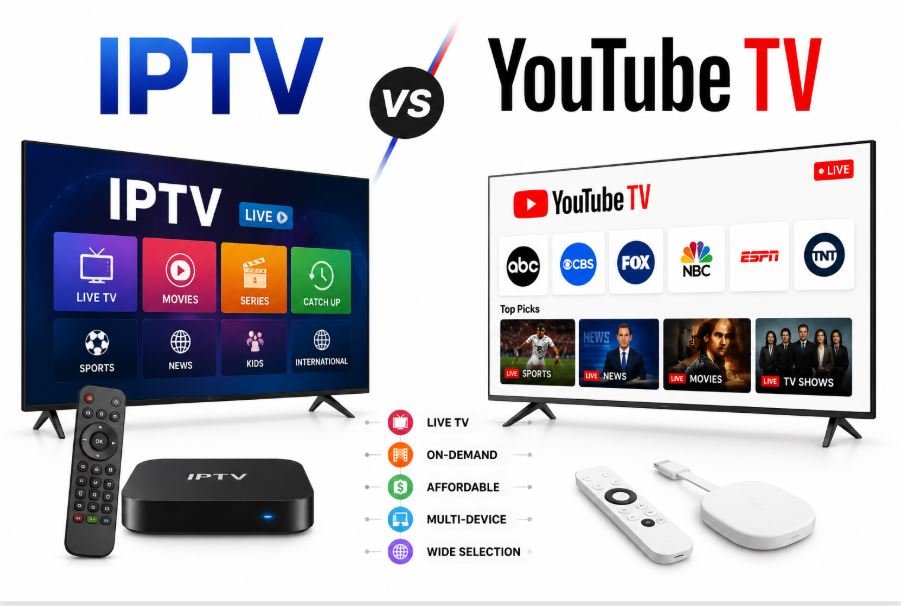
IPTV is a general method of delivering television through the internet, and individual IPTV providers can offer very different channel lineups and features. YouTube TV is a specific, managed live-TV streaming platform with a defined subscription model.
Here are some important differences:
1. Service Structure
IPTV can refer to many different providers and platforms. Some services specialize in international channels, sports, movies, or niche programming.
YouTube TV operates as one established streaming service with its own channel packages and features.
2. Channel Selection
The channel selection of IPTV depends heavily on the provider you choose. Some providers may offer international or specialized channels that are not available through mainstream streaming services.
YouTube TV focuses primarily on established television networks and channels available within its service offering.
3. Pricing
IPTV pricing varies widely depending on the provider and subscription package.
YouTube TV uses a structured subscription model, although its pricing and available plans can change over time.
4. DVR Features
Many IPTV services offer some type of recording or catch-up functionality, but the features differ from one provider to another.
YouTube TV is known for its integrated cloud DVR experience, which makes recording live programming relatively straightforward.
5. User Experience
A reputable IPTV service can provide an excellent experience, but the interface and reliability depend on the provider and application being used.
YouTube TV offers a more standardized interface and experience because the platform controls the service and its applications.
Difference Between IPTV and YouTube TV | Comparison Chart
| Feature | IPTV | YouTube TV |
|---|---|---|
| Delivery method | Internet | Internet |
| Service type | Broad technology/category | Specific live-TV streaming service |
| Channel selection | Depends on provider | Defined by YouTube TV |
| International content | Often available depending on provider | More limited |
| Live TV | Yes, depending on provider | Yes |
| On-demand content | Depends on provider | Available |
| Cloud DVR | Depends on provider | Included |
| Device compatibility | Depends on service/app | Supported devices and platforms |
| Pricing | Varies by provider | Subscription-based |
| Interface | Depends on provider/app | Standardized |
| Reliability | Depends heavily on provider | Generally consistent |
| Legal considerations | Depends on content licensing | Licensed service |
| Best suited for | Flexible and varied channel needs | Mainstream live TV viewers |
IPTV vs YouTube TV: Features Comparison
IPTV Features
A legitimate IPTV service may provide a wide range of features, such as:
- Live television channels
- Sports programming
- International channels
- Movies and TV shows
- Video-on-demand libraries
- Catch-up TV
- Electronic program guides
- Multiple device support
- Different subscription packages
- HD and higher-quality streaming, depending on the provider
The exact features vary considerably, so it is important to research a provider before subscribing.
YouTube TV Features
YouTube TV provides features designed around conventional live television streaming, including:
- Live TV channels
- Cloud DVR
- On-demand programming
- Multiple supported devices
- Personalized profiles
- A familiar streaming interface
- Sports, news, entertainment, and other programming
- Integration with the broader Google/YouTube ecosystem
Feature availability can vary by plan, location, and current service terms.
Don’t miss to know the related topics: Difference Between IPTV and Cable TV
What is the Difference Between Kodi and IPTV
Difference Between IPTV and OTT
What is the Difference Between IPTV and Streaming
Pros and Cons of IPTV
Pros of IPTV
1. Flexible Content Choices
One of IPTV’s biggest advantages is the variety of content that some providers can offer. Depending on the service, viewers may find local, international, entertainment, and sports channels in one package.
2. Wide Device Compatibility
Many IPTV applications can work across smart TVs, streaming devices, smartphones, tablets, and computers.
3. International Programming
For viewers who enjoy television from different countries, IPTV can sometimes provide more international programming than mainstream live-TV services.
4. Flexible Packages
Different IPTV providers may offer different subscription packages, allowing users to look for a service that matches their viewing needs.
Cons of IPTV
1. Quality Varies by Provider
Not every IPTV service provides the same quality. Streaming stability, picture quality, customer support, and channel availability can differ significantly.
2. Legal Issues Can Exist
The legality of IPTV depends on the provider and whether it has permission to distribute the content. Users should avoid services that offer copyrighted programming without appropriate licensing.
3. Internet Dependency
Like other internet-based TV services, IPTV requires a reliable internet connection for smooth streaming.
4. Inconsistent User Experience
Some IPTV services may use third-party applications with interfaces that are less polished than major streaming platforms.
Pros and Cons of YouTube TV
Pros of YouTube TV
1. Simple User Experience
YouTube TV provides a centralized platform, making it easier for viewers to browse live channels, programs, and recordings.
2. Cloud DVR
Its cloud DVR feature is particularly useful for viewers who frequently record live programs and watch them later.
3. Established Platform
YouTube TV is operated by Google, giving users a recognizable platform and standardized applications.
4. Strong Live-TV Focus
For viewers who want an experience similar to cable television without installing a traditional cable connection, YouTube TV can be a convenient option.
Cons of YouTube TV
1. Subscription Cost
The price may be higher than some low-cost streaming alternatives, particularly for users who watch only a small number of channels.
2. Channel Availability Depends on Location
The exact channels and local programming available can depend on the viewer’s location and current agreements.
3. Less Flexibility for Niche International Content
Viewers looking for highly specialized or international programming may find that a particular IPTV provider offers more choices.
4. Internet Required
YouTube TV is also dependent on a stable internet connection.
IPTV vs YouTube TV: Which Is Better?
There is no single answer to which is better, IPTV or YouTube TV, because the best choice depends on what you expect from a streaming service.
IPTV May Be Better If You:
- Want a broad selection of international programming
- Prefer more flexible content options
- Need specialized channels
- Want to compare different providers and packages
- Are comfortable setting up an IPTV application
- Prefer a service tailored to specific viewing interests
However, always verify that the IPTV provider is properly licensed to distribute the content it offers.
YouTube TV May Be Better If You:
- Want a straightforward live-TV experience
- Prefer a recognizable mainstream service
- Want integrated cloud DVR functionality
- Prefer a standardized user interface
- Watch mainstream news, entertainment, and sports channels
- Want less hassle when choosing and managing a provider
IPTV vs YouTube TV for Sports
Sports fans should pay close attention to channel availability before selecting a service.
IPTV may appeal to sports viewers who want access to international sports channels or specialized programming. However, availability depends on the provider and licensing agreements.
YouTube TV can be attractive to viewers who mainly follow the sports networks included in its current lineup. It also provides convenient live viewing and DVR features.
Before subscribing, check whether the service legally carries the specific league, tournament, or sports network you want to watch.
IPTV vs YouTube TV for Movies and Entertainment
The better choice depends on the type of entertainment you prefer.
Some IPTV providers offer extensive video-on-demand libraries alongside live television. This can be useful for viewers who want live channels and on-demand content in one application.
YouTube TV is more focused on live television and related on-demand programming rather than functioning as a traditional standalone movie-streaming library.
If movies are your primary interest, it can also make sense to compare either option with dedicated movie and entertainment streaming services.
IPTV vs YouTube TV for International Channels
This is one area where IPTV can have an advantage, depending on the provider.
Some legitimate IPTV platforms specialize in international programming and may offer channels from multiple countries and regions.
YouTube TV primarily targets the U.S. live-TV market, so viewers seeking a large selection of international channels should carefully check its current offerings before subscribing.
IPTV vs YouTube TV: Picture Quality
Both IPTV and YouTube TV can provide high-quality video, but your actual experience depends on several factors.
These include:
- Internet speed
- Network stability
- Device capability
- Streaming application
- Server or platform performance
- Video source quality
- Current traffic
A reputable IPTV provider with high-quality streams can deliver an excellent viewing experience. Likewise, YouTube TV can provide strong video quality when the user’s internet connection and device support smooth streaming.
The important point is that internet speed alone does not guarantee excellent streaming quality. The quality of the service itself also matters.
IPTV vs YouTube TV: Ease of Use
YouTube TV generally has an advantage in simplicity because users sign up for one service, install the official application, and access their programming through a consistent interface.
IPTV can require more setup. Depending on the provider, users may need to install a compatible application, enter account information, configure playlists, or adjust settings.
For technically confident users, this may not be a problem. For beginners who want a plug-and-play experience, YouTube TV may be easier.
IPTV vs YouTube TV: Reliability
Reliability is another major factor.
With IPTV, reliability depends strongly on the provider’s infrastructure, server capacity, application, and content sources. A low-quality provider may experience buffering, outages, or missing channels.
YouTube TV provides a more standardized experience because it controls the platform and service infrastructure. However, internet outages, regional problems, or technical issues can still affect streaming.
Therefore, when comparing IPTV vs YouTube TV, do not judge IPTV as a whole based on one provider. Different IPTV services can offer dramatically different experiences.
How to Choose Between IPTV and YouTube TV
Before making a decision, ask yourself these questions:
What Channels Do You Watch Most?
Make a list of your must-have channels. Then compare their availability on the services you are considering.
Do You Need International Content?
If international channels are important, investigate legitimate IPTV providers that specialize in your preferred regions.
Do You Need Cloud DVR?
If recording live television is important, compare DVR storage, recording rules, and playback options.
How Much Are You Willing to Spend?
Compare the total monthly cost rather than looking only at the advertised starting price.
How Important Is Simplicity?
If you want an easy setup with a standardized application, YouTube TV may be more convenient.
If you enjoy flexibility and don’t mind configuring an IPTV application, IPTV may offer more options.
How to Improve Your IPTV or YouTube TV Streaming Experience
Regardless of which service you choose, several simple steps can improve streaming performance:
- Use a reliable broadband connection.
- Connect your streaming device to a strong Wi-Fi network.
- Consider Ethernet when possible for stationary devices.
- Keep your streaming application updated.
- Use a compatible, modern streaming device.
- Close unnecessary applications that consume bandwidth.
- Choose a reputable and properly licensed service.
- Check your internet performance if buffering occurs.
Is IPTV Cheaper Than YouTube TV?
IPTV can be cheaper, but there is no universal answer.
The cost of IPTV depends on the provider, package, subscription length, and included features. Some services may be inexpensive, while others can cost significantly more.
YouTube TV follows its own subscription pricing structure, which can change over time.
Instead of comparing price alone, compare price + channel selection + reliability + features + legal licensing + customer support. A very cheap service is not necessarily better value if it frequently buffers or lacks the channels you need.
Is IPTV Legal?
IPTV technology itself is legal. The important issue is what content a provider distributes and whether the provider has the appropriate rights or licenses.
There are legitimate IPTV services, broadcasters, and streaming platforms. There are also services that may distribute copyrighted content without permission.
Before subscribing to an IPTV service, verify that it is authorized to provide the channels and content it advertises.
Frequently Asked Questions
1. What is the difference between IPTV and YouTube TV?
IPTV is a broad technology for delivering television over the internet, while YouTube TV is a specific live-TV streaming service. IPTV options vary by provider, whereas YouTube TV offers a standardized service and subscription structure.
2. Which is better, IPTV or YouTube TV?
Neither is universally better. IPTV may be better for flexibility and international programming, while YouTube TV may be better for users who want a simple and standardized live-TV experience.
3. Is IPTV cheaper than YouTube TV?
It can be, depending on the IPTV provider and package. However, users should compare total value, including channel selection, reliability, features, support, and licensing rather than price alone.
4. Can I watch live sports with IPTV?
Yes, some legitimate IPTV services offer live sports channels. The available sports depend on the provider’s content rights and channel lineup.
5. Does YouTube TV have live sports?
Yes. YouTube TV offers sports programming through the networks included in its current channel lineup. Availability can vary by location and subscription plan.
6. Can IPTV work on a Smart TV?
Many IPTV services can be accessed on compatible Smart TVs through supported applications. Compatibility depends on the specific TV, operating system, application, and IPTV provider.
7. Does IPTV require the internet?
Yes. IPTV delivers television content through an internet connection, so a stable connection is important for reliable streaming.
8. Does YouTube TV require cable?
No. YouTube TV is an internet-based live television service, so it does not require a traditional cable TV connection.
9. Which is better for international channels: IPTV or YouTube TV?
A legitimate IPTV provider may offer more international programming, depending on its licensed content. YouTube TV is primarily designed around its specific U.S. channel lineup.
10. Which is easier to use, IPTV or YouTube TV?
YouTube TV is generally easier for beginners because it provides a standardized platform. IPTV setup varies by provider and may require additional configuration.
11. Can IPTV replace cable TV?
Yes, a legitimate IPTV service can potentially replace traditional cable for some viewers. Whether it is a suitable replacement depends on the available channels, reliability, features, and licensing.
12. What should I check before choosing an IPTV provider?
Check its licensing, channel lineup, supported devices, video quality, reliability, customer support, pricing, refund policy, and user experience before subscribing.
Conclusion
The debate over IPTV vs YouTube TV does not have one winner for everyone. Both deliver television through the internet, but they serve different needs.
IPTV can provide greater flexibility and access to specialized or international programming when using a legitimate provider. YouTube TV offers a more consistent and user-friendly experience for viewers looking for mainstream live television and integrated features.
The smartest approach is to identify your must-have channels, budget, preferred devices, DVR requirements, and viewing habits. Once you know what matters most, choosing between IPTV and YouTube TV becomes much easier.
IPTV can be a strong choice for viewers who want varied programming, international channels, specialized content, and flexibility. However, the experience depends heavily on the provider, and users should always choose a legitimate, properly licensed service.
YouTube TV is a more standardized option for viewers who want a straightforward live-TV streaming experience, recognizable programming, cloud DVR functionality, and a consistent platform.
Choose IPTV if flexibility and specialized content are your priorities. Choose YouTube TV if simplicity, mainstream live television, and a standardized experience matter more.
Before making your final decision, compare the current channel lineup, pricing, supported devices, DVR features, local availability, and licensing of the service you plan to use.

4 thoughts on “IPTV vs YouTube TV | Which Is Better for Streaming in 2026?”